What matters. What to do next. This is an illustrative review of an established UK business with a bespoke product. Company details are anonymised, and nothing here is presented as a proven result.
This report shows the approach and the decisions, without publishing a client’s confidential records.
The Company
A trading business with a bespoke product offer, referred to only as the Company. Names, identifying details and commercial figures are withheld or generalised for public use.
What this sample is based on
The owner’s account of the business, the problems identified, the cost comparisons made and the actions taken. It is an illustrative adaptation, not an independently verified financial assessment.
How to read the findings
Owner observations are attributed where material. Proposed actions are separated from decisions already taken. The website and CRM changes are still in progress. No increase in sales or realised savings is presented as proven.
What is not claimed
Competitor sales and profits have not been established. Missing customer loss records limit conclusions about why buyers leave. The report does not invent those answers or publish private figures.
Purpose
Show how the Company’s knowledge, records and outside view can be connected to practical decisions. The next review would test those decisions against fresh evidence.
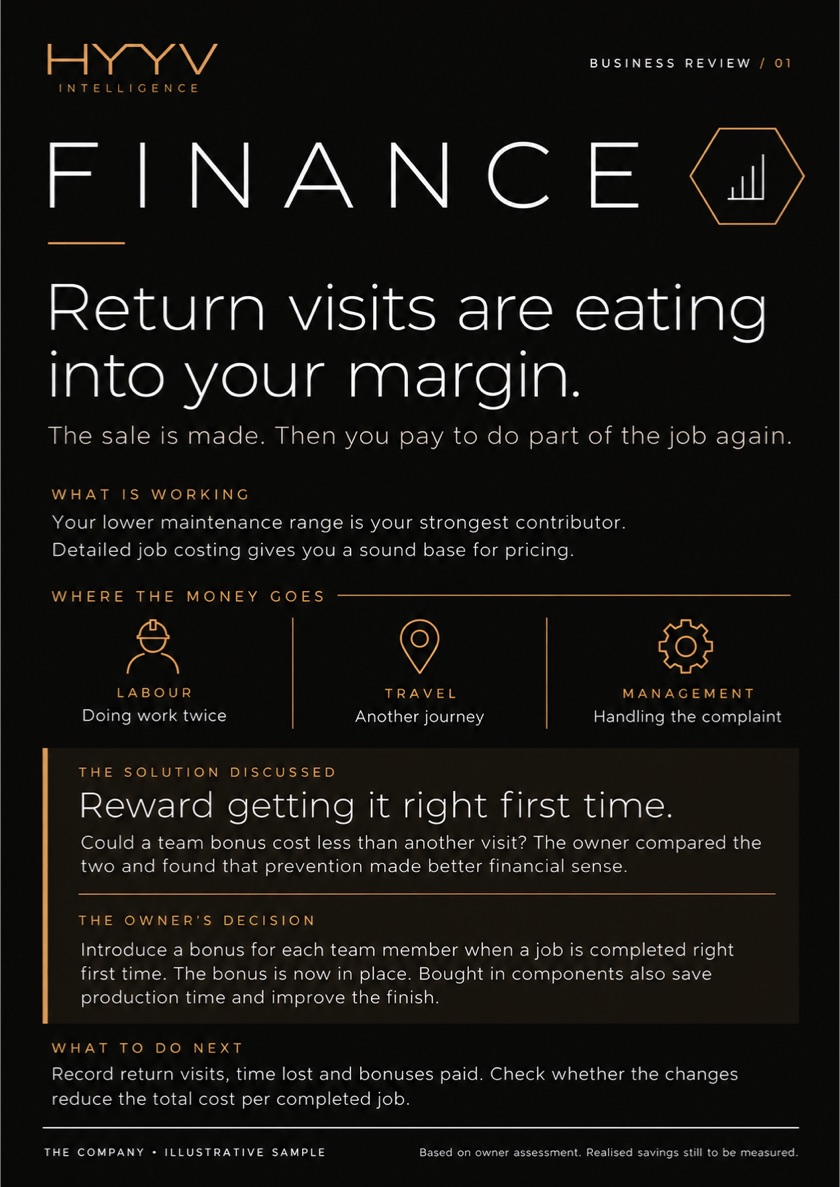
01Finance
Return visits are eating into your margin.
The sale is made. Then you pay to do part of the job again.
What is working
Your lower maintenance range is your strongest contributor. Detailed job costing gives you a sound base for pricing.
Where the money goes
Labour: doing work twice.
Travel: another journey.
Management: handling the complaint.
Solution discussed: reward getting it right first time
Could a team bonus cost less than another visit? The owner compared the two and found that prevention made better financial sense.
Owner’s decision
Introduce a bonus for each team member when a job is completed right first time. The bonus is now in place. Bought-in components also save production time and improve the finish.
What to do next
Record return visits, time lost and bonuses paid. Check whether the changes reduce the total cost per completed job.
Based on owner assessment. Realised savings still to be measured.
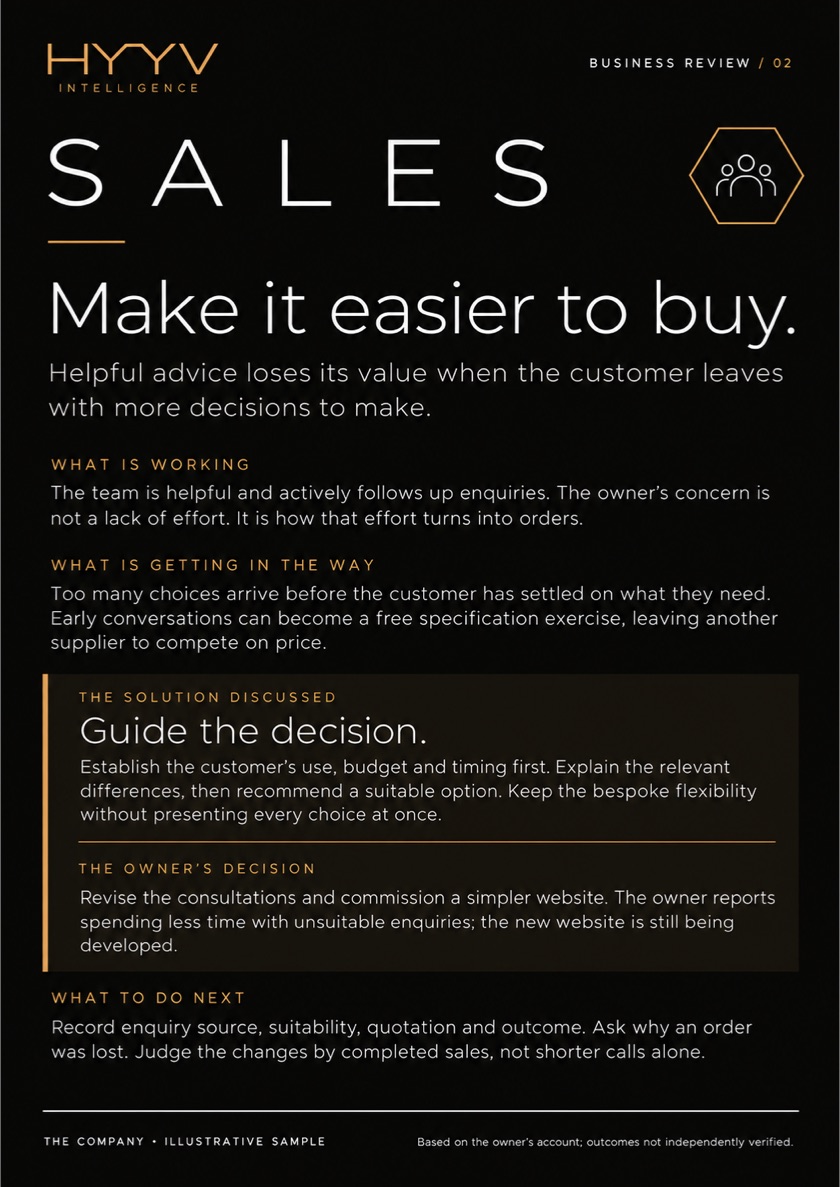
02Sales
Make it easier to buy.
Helpful advice loses its value when the customer leaves with more decisions to make.
What is working
The team is helpful and actively follows up enquiries. The owner’s concern is not a lack of effort. It is how that effort turns into orders.
What is getting in the way
Too many choices arrive before the customer has settled on what they need. Early conversations can become a free specification exercise, leaving another supplier to compete on price.
Solution discussed: guide the decision
Establish the customer’s use, budget and timing first. Explain the relevant differences, then recommend a suitable option. Keep the bespoke flexibility without presenting every choice at once.
Owner’s decision
Revise the consultations and commission a simpler website. The owner reports spending less time with unsuitable enquiries. The new website is still being developed.
What to do next
Record enquiry source, suitability, quotation and outcome. Ask why an order was lost. Judge the changes by completed sales, not shorter calls alone.
Based on the owner’s account; outcomes not independently verified.
03Customer expectations
Make the difference clear.
A customer cannot value a difference they do not understand.
What is working
Customers praise the staff, often by name. The owner reports no recurring confusion around warranties, maintenance or electrical work. Keep those strengths.
What needs attention
Online, similar-looking products can appear interchangeable. The owner believes early enquiries sometimes compare price before understanding the specification or finish. Lost sale records do not yet establish how often this happens.
Solution discussed: show what the customer is paying for
Use simple comparisons, clear photographs and a guided explanation of the relevant choices. Confirm the final specification before work begins.
Owner’s decision
Introduce a final specification check. The owner reports fewer issues since doing so. The new website should make the product differences easier to understand.
What to do next
Record misunderstandings, specification changes and complaints. Check whether customers know exactly what they are buying before they commit.
Based on the owner’s account; outcomes not independently verified.
04Operations
Stop paying to do work twice.
Time spent correcting yesterday’s job cannot be used on tomorrow’s order.
What is working
The team already delivers the product and runs daily operations. Bought-in components are producing a better finish while reducing production time, according to the owner.
What limits output
Return visits interrupt planned work. Some individually made components take more time than they justify. The owner also sees available staffing as a limit on weekly output.
Solution discussed: simplify the work, protect the finish
Keep the bespoke choices customers value. Standardise repeatable work behind the scenes and check quality before dispatch.
Owner’s decision
Buy in selected components and introduce a right-first-time bonus. These changes are in use. The time released has not yet been translated into a verified increase in weekly capacity.
What to do next
Track hours per job, return visits and delivery reliability. Identify the actual bottleneck before adding labour or accepting more orders.
Based on the owner’s account; outcomes not independently verified.
05Management
Make good work repeatable.
A better team needs clear standards as well as goodwill.
What is working
The owner describes a stronger team that keeps the business running without daily supervision. Staff receive positive customer feedback. That is a useful base to build on.
What needs attention
When the same mistake returns, an informal reminder is not enough. A procedure only helps if somebody owns it and checks that it is followed.
Solution discussed: make the standard visible
Define what a completed job looks like, who checks it and what happens when something fails. Use a short review of recurring issues to improve the process.
The owner’s decision
Introduce a right-first-time bonus and put procedures in place when problems arise. The reward gives the team a practical reason to protect quality.
What to do next
Agree responsibility for each quality check. Review repeat faults and whether the new procedure prevents them. Reward a reliable result, not a box being ticked.
Based on the owner’s account; outcomes not independently verified.
06Risk
More orders can multiply a small problem as quickly as they increase sales.
What is working
The business has alternatives across several supply areas. Research also helped the owner find suppliers they had not previously considered.
Where exposure remains
Limited sales records make marketing decisions harder to judge. Return visits consume spare capacity. A new website will not solve either issue unless the supporting processes work.
Solution discussed: check the dependencies first
Test supplier alternatives, verify the website enquiry journey and connect it properly to the CRM. Keep visibility of open quotations and delivery commitments during the change.
Open decisions and actions
The website and CRM work are under development. Supplier options have broadened. Testing alternative suppliers and setting launch checks are recommended next steps, not completed work.
What to do next
Assign an owner to each launch check. Test enquiry capture, follow-up and order records before increasing advertising. Confirm the team can fulfil the demand.
Based on the owner’s account; outcomes not independently verified.
07Owner independence
Keep oversight. Avoid becoming the bottleneck.
The aim is control without needing to make every decision yourself.
What is working
The team already runs the business while the owner is away. The owner stays involved by choice and believes they could step back further. This is not a business shown to depend on the owner for every task.
What needs protecting
Important judgement can still sit in people’s heads. Growth becomes harder if those decisions are not understood by the next person who needs to make them.
Solution discussed: record how decisions are made
Capture the practical rules for quoting, resolving complaints and approving exceptions. Give the team clear boundaries for when to act and when to escalate.
Current position
Day-to-day delegation is already in place. A written decision guide and a concise performance dashboard are proposed improvements. They have not been verified as implemented.
What to do next
Track which questions still reach the owner. Document the recurring ones first. Test whether the team can resolve them consistently without another call.
Based on the owner’s account; outcomes not independently verified.
08Market intelligence
Learn from the buying journey.
A competitor can make the decision easier without making a better product.
What the owner found
The owner’s comparison of competitor websites exposed a gap in how clearly the Company presented its offer. Some competing brands appeared to make buying simpler and justify a higher price.
What this means
The useful lesson is about presentation and customer choice. Competitor sales volumes and profitability have not been verified for this sample. A polished website alone does not prove stronger performance.
Solution discussed: compare the customer experience
Review how competitors explain ranges, demonstrate quality and guide enquiries. Separate useful ideas from claims the Company cannot substantiate.
Owner’s decision
Commission a clearer website while retaining bespoke options. Office use has also emerged in the owner’s assessment as a promising customer need to address.
What to do next
Test messages by customer use and enquiry quality. Record what buyers compare and why they choose or reject the Company. Build the next decisions on those answers.
Based on the owner’s account; outcomes not independently verified.
09Growth
Convert better before spending harder.
More traffic is not enough if the buying process loses the right customers.
What is working
The owner reports a profitable business, a capable team and a product customers value. The objective is to grow sales while keeping more of the money earned.
What holds growth back
The owner considers conversion too low. Targeting, product explanation and missing CRM detail make it difficult to establish where enquiries are lost or which advertising pays its way.
Solution discussed: improve the whole route to an order
Connect advertising, the website, consultations and follow-up. Use the CRM to see which enquiries become profitable work.
Owner’s decision
Invest in a new website, better CRM capture and AI-supported administration. Consultations are being revised. These are changes in progress, not evidence of a sales uplift.
What to do next
Compare enquiry quality, conversion and margin after launch. Watch sales in quieter months and delivery capacity. Increase spend when the evidence supports it.
Based on the owner’s account; outcomes not independently verified.
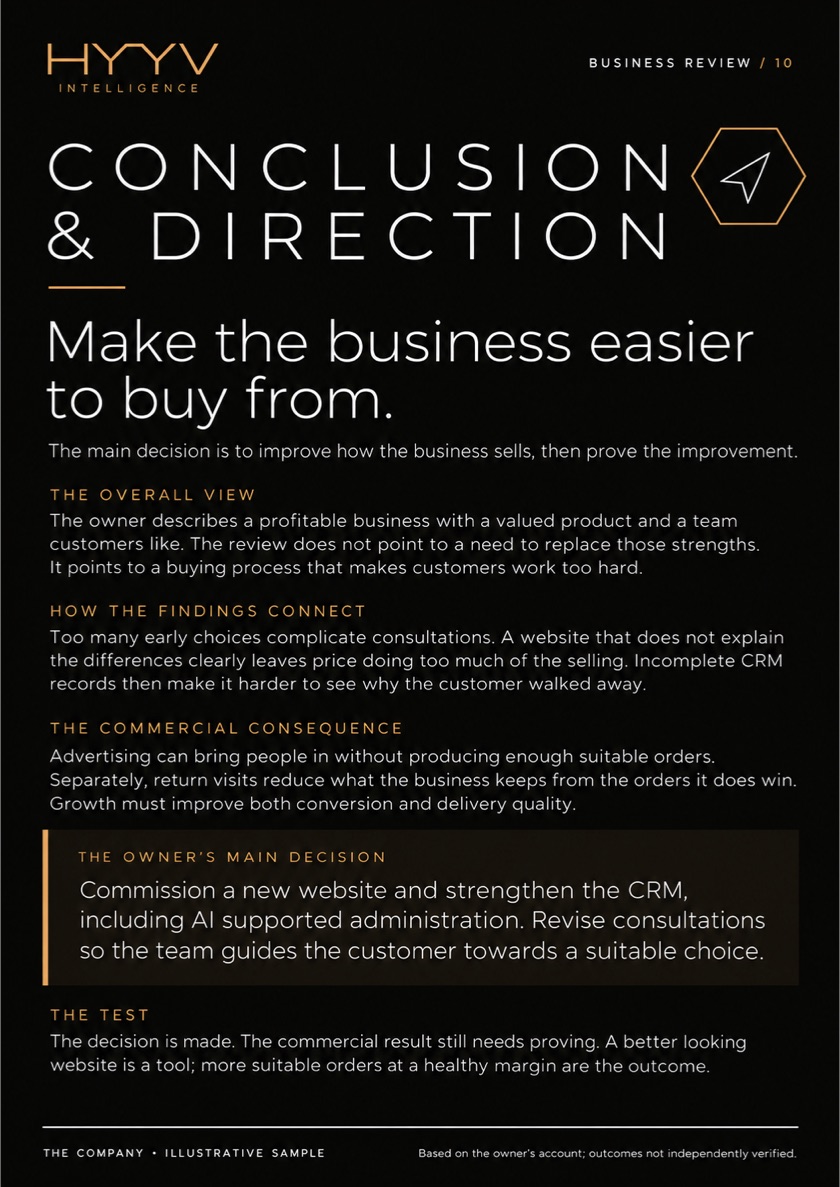
10Direction
Make the business easier to buy from.
The main decision is to improve how the business sells, then prove the improvement.
Overall view
The owner describes a profitable business with a valued product and a team customers like. The review does not point to a need to replace those strengths. It points to a buying process that makes customers work too hard.
Connected findings
Too many early choices complicate consultations. A website that does not explain the differences clearly leaves price doing too much of the selling. Incomplete CRM records then make it harder to see why the customer walked away.
Commercial consequence
Advertising can bring people in without producing enough suitable orders. Separately, return visits reduce what the business keeps from the orders it does win. Growth must improve both conversion and delivery quality.
Owner’s main decision
Commission a new website and strengthen the CRM, including AI-supported administration. Revise consultations so the team guides the customer towards a suitable choice.
Closing line
The decision is made. The commercial result still needs proving. A better-looking website is a tool. More suitable orders at a healthy margin are the outcome.
11The sales plan
Help customers choose. Then learn why they buy.
The new website and the conversation must work as one sales process.
Clarify the offer
Present a manageable starting point for each customer need. Explain the differences that affect suitability, finish and value. Keep bespoke options available without asking customers to design the whole solution before committing.
Guide the conversation
Establish use, timing and budget before a detailed specification. Give a recommendation with a reason. The team should remain helpful, but the conversation needs a clear next step.
Connect the records
Capture source, customer need, quoted option, follow-up and final outcome. The team already chases customers. The improvement needed is a better record of what happens and why.
Support the administration
Use the planned tools to organise information and support follow-up. Keep responsibility for accuracy and customer promises with the team. Automation is only useful if it makes the process more reliable.
What will show progress
Review suitable enquiries, quotations and completed sales together. Ask lost customers why they chose elsewhere. Compare like periods and record changes in spend, price and season.
12Keeping more of each sale
More sales must leave more money behind.
Fixing the sales process and protecting delivery quality belong in the same plan.
Keep the strong contributor visible
The owner identifies the lower maintenance range as the strongest contributor. Check that job costing includes the full work involved, including extra visits. A profitable quotation can become a weaker job once correction costs are added.
Measure the quality decision
The owner introduced a team bonus after comparing it with the cost of returns. Record bonuses paid, faults and the full cost of remedial work. The case for prevention is clear. The saving achieved needs to be measured.
Turn saved time into useful capacity
Bought-in components are reported to save time and improve finish. Establish where that released time goes. It may help reliability, reduce overtime or support more jobs. Do not assume it automatically creates an extra sale.
Match demand to delivery
The owner sees staffing as a limit on weekly output. Before increasing demand, check where work queues build up and whether fewer defects relieve the pressure. Add capacity against a demonstrated need.
Commercial rule
Judge growth by the money retained and the promises kept. Turnover alone will not tell you whether the changes are working.
13Launch, measure, decide
Launch. Measure. Make the next decision.
Use the next review to test the changes, not simply repeat the recommendations.
Already in motion
The owner has introduced the quality bonus, selected bought-in components and started a final specification check. Consultations are being revised. The website and CRM work remain in development.
Before launch
Agree the website journey and test every enquiry route. Confirm that records reach the CRM and someone owns the next action. Write down the current sales and quality measures so there is a meaningful starting point.
After launch
Review enquiry quality, quotations, sales, advertising cost and job margin. Track return visits alongside bonuses. Include quiet periods as well as busy ones. Investigate the reasons behind a change before attributing it to the website.
At the next HYYV review
A follow-up review is proposed once there is enough evidence. Examine what improved, what did not and what needs adjusting. Continue, change or stop each initiative on its merits. No follow-up result is claimed in this sample.
Conclusion
Simplify buying. Capture the reasons behind sales. Deliver right first time. Then invest further where the evidence shows the business is getting stronger.
Your business. Your question.
Every review is built around the owner’s own question. This one was about growth. Yours might be about buying, selling, fixing something or stepping back. The approach is the same: listen widely, cross-reference everything and be honest about what is proven and what isn’t.